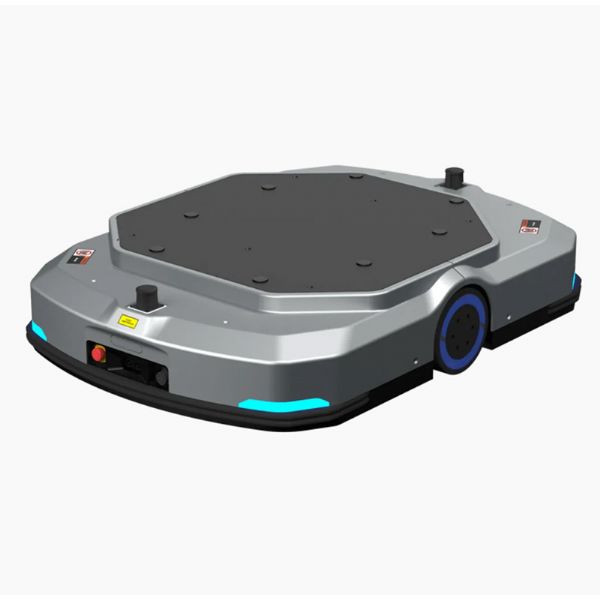
The JCAMB-CSW10-BH is a 1-ton autonomous mobile robot chassis designed for manufacturers building AGVs, AMRs, autonomous forklifts, warehouse transport robots, and industrial logistics systems.
SLAM or Simultaneous Localization and mapping s a method used in robotics and navigation that allows a device to build a map of an unknown environment while simultaneously tracking its own location within that map. SLAM technology plays a critical role in autonomous systems, like mobile robot chassis. It enables our mobile robot chassis to navigate complex environments without relying on pre-existing maps or external positioning systems like GPS. SLAM systems combine sensor data, mathematical algorithms, and real-time computing to create accurate maps and track movement. The main challenge is solving two problems at once: figuring out where the system is and what the environment looks like.
QR code navigation uses strategically placed floor markers to provide robots with precise location references throughout a facility. By scanning these codes during operation, the robot continuously verifies its position and follows predefined routes with high accuracy.
In a smart warehousing system, reflector plates serve as celestial stars in the night sky, providing absolute coordinate references for mobile robots. As core ground infrastructure enabling centimeter-level accuracy, reflector plates have become the preferred navigation solution for precision-driven scenarios like smart factories and logistics, leveraging their stable reflective properties.
Dual LiDAR sensors monitor the robot's surroundings from multiple directions, providing comprehensive environmental awareness and enhancing operational safety.
An optional 3D camera provides depth perception, allowing the robot to identify obstacles that may not be fully detected by standard LiDAR sensors.
Contact-sensitive collision strips provide an additional layer of safety by immediately stopping the robot if physical contact occurs.
Obstacle avoidance is a crucial component of autonomous navigation and control systems in robotics. It is the ability of a robot or an autonomous system/machine to recognize and avoid obstacles in order to arrive at a predetermined location. This technology is essential to many industries, such as smart warehousing and industrial automation. Robots can function securely and effectively in dynamic and complicated situations by avoiding obstacles, which lowers the possibility of collisions and damage.
1. Heavy Material Transport & High-Density Smart Warehousing
In modern automated warehouses, transferring heavy pallets and bulky components requires both high payload capacity and pinpoint accuracy. The JCAMB-CSW10-BH serves as the ultimate heavy-duty AMR chassis for building custom pallet-lifting robots and automated warehouse tuggers.
Our solution: With a 1-ton (1000 kg) load capacity and an ultra-compact chassis length, it handles heavy payloads effortlessly while navigating tight warehouse aisles. Utilizing QR code or reflector navigation, the chassis achieves an exceptional ±5 mm positioning accuracy, ensuring seamless alignment with automated conveyor belts, racks, and pallet pickup stations. It provides warehouse operators with a highly reliable, cost-effective platform to scale their autonomous fleet without prohibitive infrastructure costs.
2. Dynamic Autonomous Navigation on Busy Manufacturing Floors
Industrial factory floors are highly dynamic environments filled with moving workers, forklifts, and changing layouts. Standard mobile platforms often struggle with safety and adaptive routing in these scenarios.
Our solution: Equipped with a hybrid navigation system, our mobile robot chassis uses SLAM navigation to build real-time maps and adapt instantly to layout modifications without requiring floor markers. Safety is handled through a 360° dual-laser LiDAR configuration paired with an optional 3D camera that actively scans for floor potholes, low-hanging obstacles, and debris. If unexpected physical contact occurs, front and rear contact-type collision strips guarantee an immediate safety stop, making it perfectly suited for safe, co-bot operations alongside factory personnel.
3. Custom AGV/AMR Fleet Development for Systems Integrators
For robotics OEMs and systems integrators, building a mobile robot from scratch is time-consuming and expensive. They need a flexible, open-architecture vehicle platform that easily accepts various upper-level mechanisms like robotic arms, roller conveyors, or scissor lifts.
Our solution: The JCAMB-CSW10-BH Mobile Chassis functions as a highly adaptable, general-purpose vehicle manufacturing platform. It features rich, mainstream expansion interfaces including RS485, CAN Bus, and digital/analog I/O, allowing developers to easily bridge upper-level hardware with the chassis control system. Combined with specialized operating and scheduling software for fleet management, it dramatically slashes R&D timelines and lowers manufacturing costs to a fraction of traditional platforms, serving as the ideal foundation for scalable industrial logistics solutions.
Popular Keywords: Pallet Jack Robot , Stacker Crane